
Farm Pig Care in Canada: Standards, Housing, and Welfare
How pigs are raised and protected on Canadian farms, the national code behind their care, and where the current rules live.
Pigs make up one of Canada’s biggest livestock sectors, and how they are cared for is set out in a national rulebook rather than left to habit. This page walks through the essentials: how pigs are housed, fed, and handled, what the standards demand, and how the practices have shifted in recent years. For the binding wording, we send you to the bodies that keep the rules current.
Pig farming in Canada
13.8M
hogs on Canadian farms (July 2025)
1.2M
sows and gilts in the breeding herd
81%
of the herd in Quebec, Ontario and Manitoba
$23.8B
annual economic activity from pork
Sources: Statistics Canada (Livestock estimates, July 2025); Agriculture and Agri-Food Canada.
Pig farming is one of the larger livestock sectors in the country. Statistics Canada counted 13.8 million hogs on farms as of July 2025, including roughly 1.2 million sows and gilts in the breeding herd. Production is concentrated, with Quebec, Ontario, and Manitoba together holding about 81 percent of the national inventory. That scale is one reason farm pig care is governed by a detailed, written national standard rather than left to custom.
The standard behind farm pig care
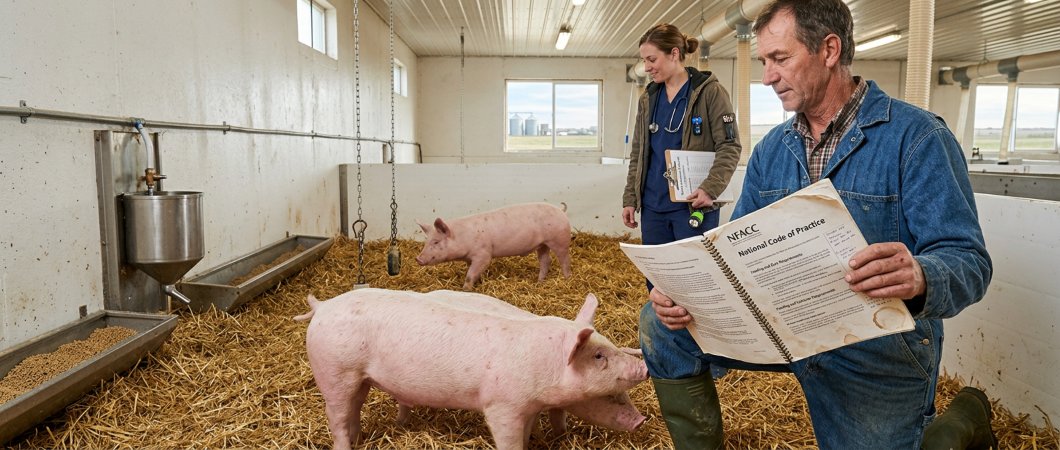
Care on Canadian pig farms is guided by the Code of Practice for the Care and Handling of Pigs, published in 2014 by the National Farm Animal Care Council (NFACC). It covers housing, feeding, handling, health, transport, and the procedures pigs undergo on farm. An update to the pig code was initiated in 2024, so parts of it are under review. The current text and any revisions are published by NFACC.
As with every code, the standards come in two forms. Requirements are mandatory and can be checked through industry assessment programs or backed by regulation. Recommended Practices describe better care that is encouraged but not obligatory. The distinction matters when reading anything about farm pig care: a Requirement sets the floor, while a Recommended Practice points to where the sector would like farms to go.
The pig code did not start from nothing. Earlier guidance, including a 2003 code for early weaned pigs, was coordinated by the Canadian Agri-Food Research Council before that role passed to NFACC in 2005. Those older documents are now superseded, and for the current rules we point to the National Farm Animal Care Council pig code rather than the archived versions.
How pigs are housed
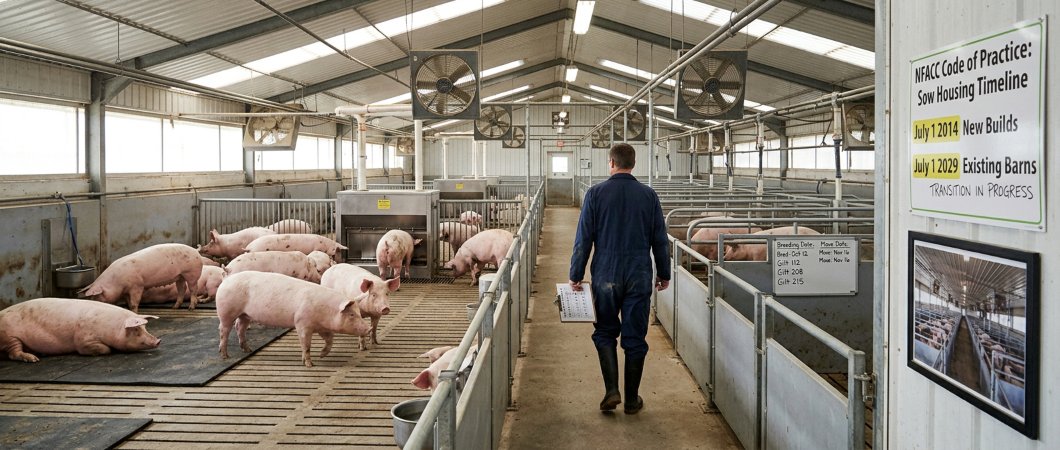
Housing is the part of farm pig care that has changed most. The biggest shift concerns sows, the breeding females, and the move away from individual gestation stalls toward group housing.
Group housing for sows, in brief
Barns built, rebuilt, or brought into use after July 1, 2014 must house mated gilts and sows in groups.
For existing operations, the transition to group housing was extended from 2024 to July 1, 2029.
Sows may still be kept in individual stalls for a limited period after breeding, generally up to about 28 to 35 days, to support early pregnancy.
The reasoning, as summarized in the code’s scientific review, is that grouped or loose housing gives sows more freedom of movement and room for natural behaviour, while a short period of individual housing after breeding can reduce aggression and injury. Both systems carry trade-offs, which is part of why the transition has been phased in over years rather than imposed at once.
Day-to-day farm pig care
Beyond housing, farm pig care follows the animals through a fairly standard lifecycle. Sows give birth in a farrowing area, with litters that commonly run from 10 to 14 piglets. Piglets nurse for roughly three to four weeks before weaning, then move to nursery housing grouped by size and onto a grain-based diet. They are moved again to finishing housing as they grow, reaching a market weight of around 120 kilograms at about six months of age.
10 to 14
piglets in a typical litter
3 to 4 weeks
nursing before weaning
120 kg
market weight, near 6 months old
Source: general Canadian production figures; SPCA sector descriptions, 2025.
The code also addresses comfort and behaviour. It calls for rooting material such as straw, shredded paper, or sawdust to be provided to weaned pigs, partly to prevent tail-biting, and it sets expectations for feed, water, and handling. Recent amendments added mandatory training in animal behaviour and humane handling for anyone working with pigs, which reflects how much of good pig care comes down to stockmanship rather than equipment alone.
Painful procedures and pain control
Some routine on-farm procedures are painful, and this is where farm pig care has tightened most clearly. Pigs may be castrated, tail-docked, or have teeth clipped, and the code now sets pain-control expectations that did not exist a decade ago.
| Procedure | What the code requires |
|---|---|
| Castration, any age | Analgesia required since July 2016 to control post-procedure pain |
| Castration after 10 days of age | Anaesthetic in addition to analgesia is required |
| Tail docking, when needed | Done as early as possible, with analgesia to control pain |
| Teeth clipping | Discouraged as a routine practice and now less common |
Sources: NFACC Code of Practice for the Care and Handling of Pigs (2014); Canadian Veterinary Medical Association.
The Canadian Veterinary Medical Association treats surgical castration as painful at any age and recommends it be done early, generally between three and seven days, with appropriate pain relief. The code reflects that thinking: analgesia is required for castration at all ages, and an anaesthetic is also required when piglets are castrated after 10 days. Tail docking, where it is done, is meant to happen as early as possible with pain control, and routine teeth clipping has fallen out of common use.
Where to find the current standards
For anything that carries weight, the current pig code is the place to look, and it is published by the National Farm Animal Care Council. Inventory and production figures come from Statistics Canada, and Agriculture and Agri-Food Canada publishes sector data and market information. If you need one of the older codes, such as the 2003 early weaned pigs code, the better route is an official or archived copy rather than a rehosted one, since those versions have been superseded.