
Codes of Practice for the Care and Handling of Farm Animals in Canada
What the codes are, how they are made, who keeps them current, and where the binding versions live.
We put this together to explain how farm animals are protected in Canada through written standards called codes of practice. Two of these codes, for laying hens and for veal calves, drew a lot of public attention over the years, so we cover them in plain terms. Where the exact wording matters, we link to the current official text instead of restating it.
The two codes covered here
| Code | Current version | Replaced | Maintained by |
|---|---|---|---|
| Pullets and Laying Hens | 2017, amended 2025 | 2003 CARC layer code | NFACC |
| Veal Cattle | 2017 | 1998 CARC veal code | NFACC |
Source: National Farm Animal Care Council.
What the codes of practice are
In Canada, the way farm animals are looked after is spelled out in documents called codes of practice. Each one is tied to a particular kind of animal, a species or a closely related group, and walks through the everyday side of farming: how animals are kept, what they are fed, how they are moved and handled, and so on. None of this sits in a single statute. What trips people up is that a code mixes two kinds of provisions, and they do not carry the same weight.
Requirements
These are the obligations. A Requirement may be backed by federal or provincial law, or checked through the assessment programs that industry runs, and it sets the floor that everyone responsible for the animals has to meet.
Recommended Practices
These point toward better care without forcing it. Think of them as the direction the sector would like farms to head in, rather than a line that must not be crossed.
Source: National Farm Animal Care Council.
How the codes are developed, and who maintains them now
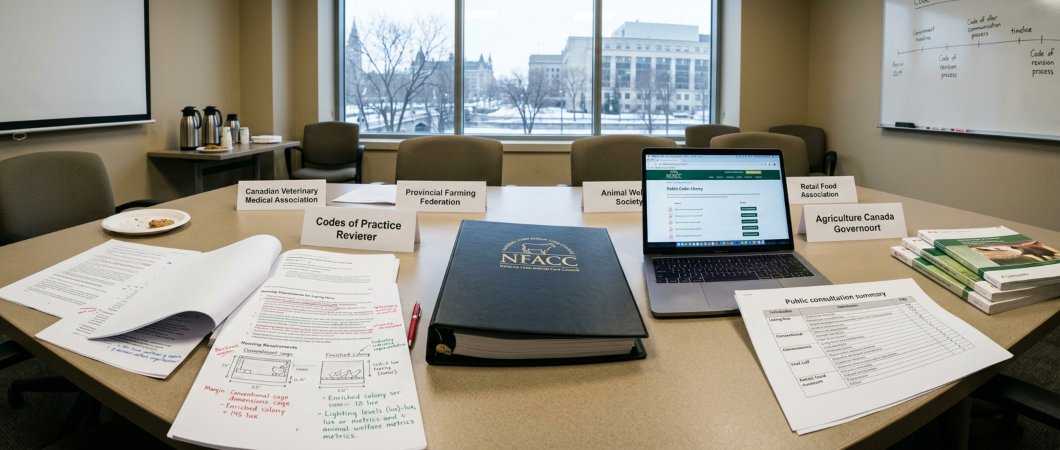
These days the codes are run by the National Farm Animal Care Council (NFACC), which has been the country’s main body for code development and farm animal care since 2005. The effort goes back further, though. Coordination of livestock codes started with the Canadian Federation of Humane Societies in 1980, passed to the Canadian Agri-Food Research Council for the decade between 1993 and 2003, and landed with NFACC in 2005, which rebuilt the whole process over 2007 and 2008.
Writing a code is a group job. A committee pulls together farmers, scientists, veterinarians, welfare advocates, and government, a separate scientific panel weighs the research, and a round of public comment runs before anything is locked in. Each code comes back up for revision roughly once a decade. Five are moving through that cycle in 2026, beef cattle, horses and donkeys, and sheep among them, with funding from the federal AgriAssurance Program. Every current code is posted by NFACC, and the council works alongside government partners including Agriculture and Agri-Food Canada and the Canadian Food Inspection Agency.
The code for pullets, layers and spent fowl
The standard covering egg-laying hens is the Code of Practice for the Care and Handling of Pullets and Laying Hens, published in 2017 and amended in 2025. It replaced the older 2003 layer code that the Canadian Agri-Food Research Council had coordinated.
The 2017 code is best known for moving the egg sector away from conventional, or battery, cages. The Canadian Veterinary Medical Association reads it as requiring battery cage systems to be phased out by 2036, with enriched and cage-free systems treated as acceptable alternatives. The shift is well along: by 2025 the share of the national flock in conventional cages had fallen to 39.5 percent, from 52.9 percent in 2021.
Canada’s egg sector in 2025
39.5%
of hens still in conventional cages
52.9 to 39.5%
decline in cage housing since 2021
937M
dozen eggs produced, up 7.6% in a year
Source: Egg Farmers of Canada, 2025 figures (reported March 2026).
For the full wording, we point to the current poultry code on the NFACC site.
Veal calves and the grain-fed definition
The current standard here is the Code of Practice for the Care and Handling of Veal Cattle, published in 2017. It replaced the 1998 veal code from the Canadian Agri-Food Research Council, which is the document many older citations and links still point to. The code applies to cattle raised for milk-fed and grain-fed veal, as well as to dairy feeder calves during the starting period.
It also carries the definitions the earlier code made familiar. In plain terms, grain-fed veal describes calves that start on milk or milk replacer and then move onto a grain ration before being finished to market weight, while milk-fed veal describes calves kept mainly on a milk-based diet with some grain or fibre. We paraphrase rather than reproduce the code; for the exact definitions and the welfare standards around them, see the current veal code on the NFACC site.
Reading or citing the historical codes
If you need one of the older codes, the 1998 veal code or the 2003 layer code that CARC coordinated, the better move is to use an official or archived copy rather than a rehosted one. NFACC keeps the current editions, and earlier federal and Council publications survive through library collections and public web archives. Citing the archived original keeps a reference stable and avoids passing off a superseded version as the one in force.